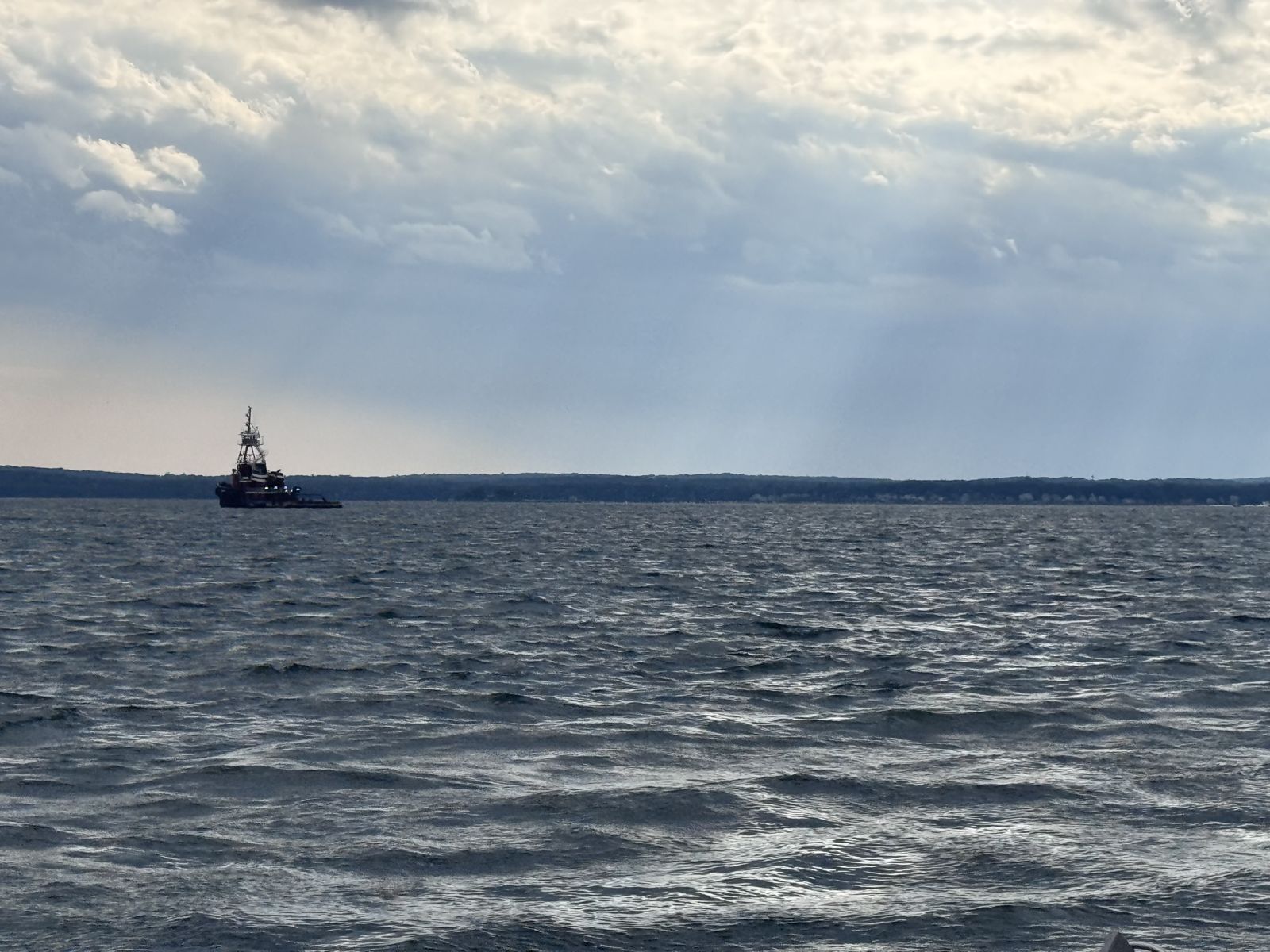
Wiley asked how many raindrops would fall in the nor’easter. I said somewhere in the quintillions, which turned out to be right and completely useless. Neither of us could picture it. So we started pouring the storm into things we knew. Twenty million swimming pools. Seventeen and a half Lake Washingtons. About one Chesapeake Bay.
The one that stuck with me was Narragansett Bay. On a map it’s four times the size of Lake Washington, and it holds less water. The lake is four times deeper. A map shows you the surface and nothing else.
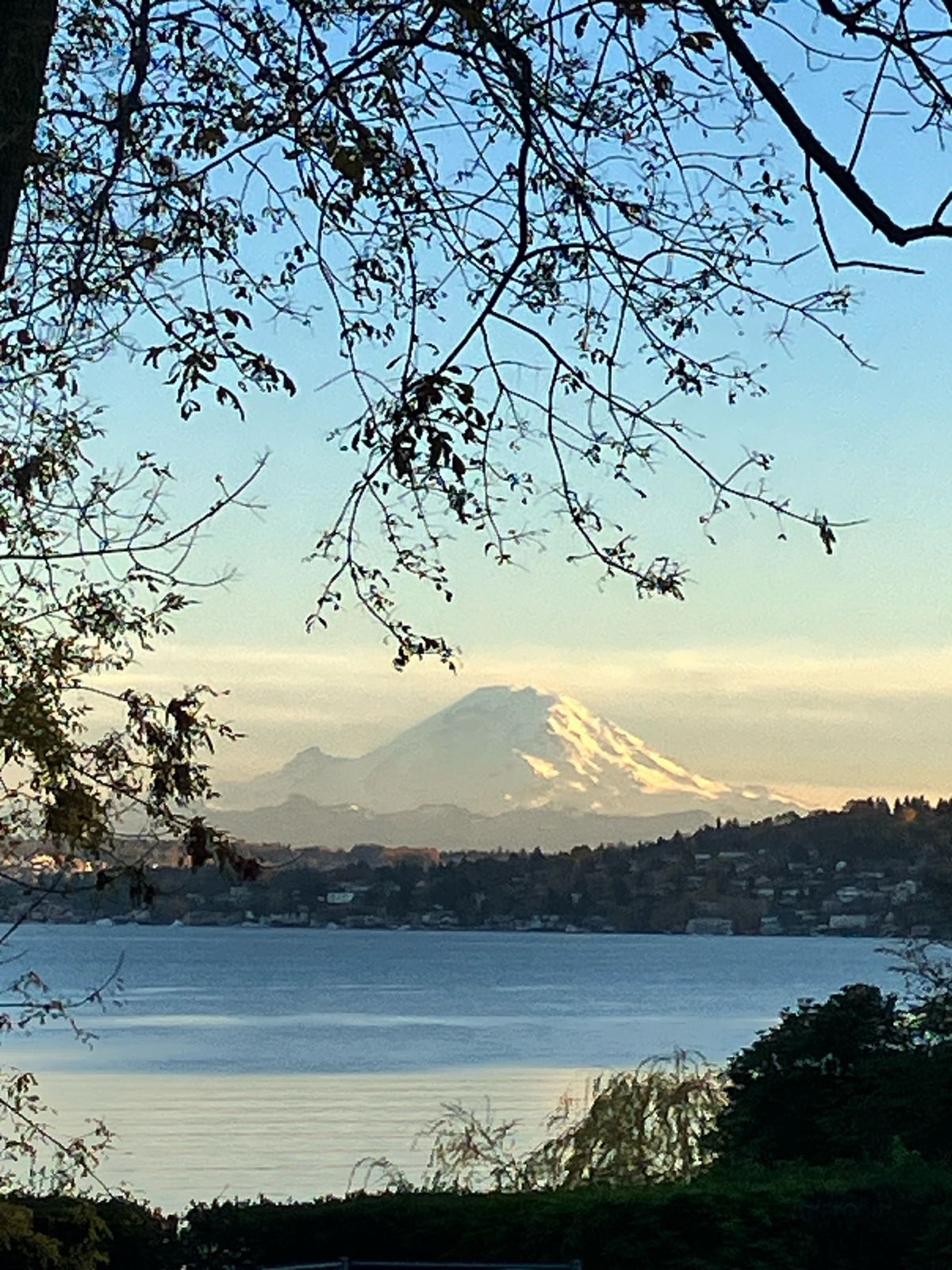
A nor’easter is two weather systems running into each other. So is most conversation. I show up with whatever I’m carrying that day, the other person shows up with theirs, and where they meet is a particular body of water with its own shape and depth.
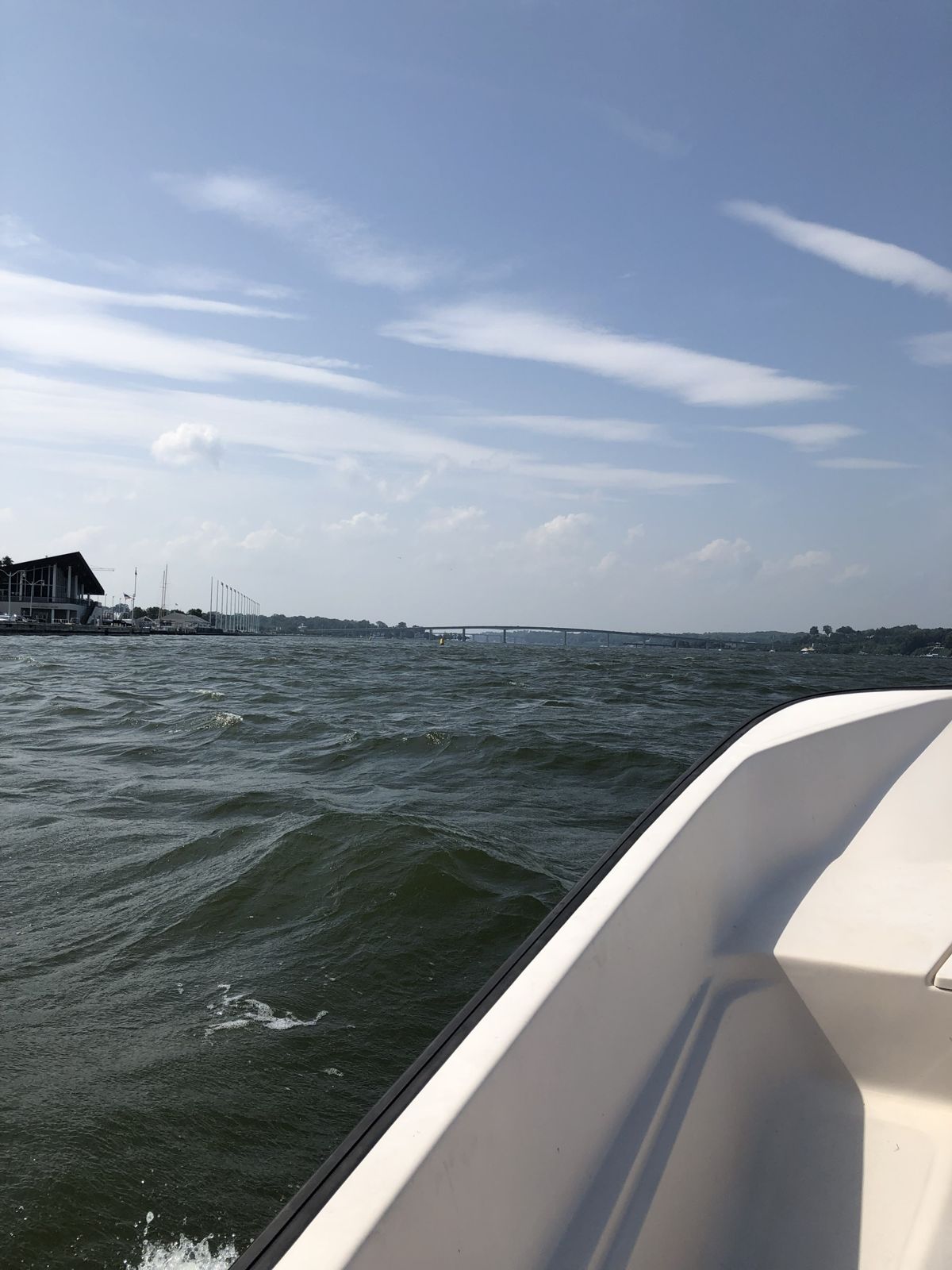
A business partner is one kind of bay. He wants the number first, and the story if we have time. The person you’re married to is another. She needs to know what it means for the two of you before the number is worth hearing. The dog is shallow and wide open. Tone of voice, and whether a leash is involved.
The storm is not the same every time. The speed and volume of the deluge keep changing, and so too changes the vessel, the two combining to determine how quickly the banks flood. And shoreside structures get undermined by the storm surge.
The mistake is reading the surface. Some conversations look enormous and hold about a foot of water. Some narrow little ones go down two hundred feet, and everything you pour in stays.
Turns out there’s a word for this. Hermeneutics is the study of how we interpret what reaches us, and Hans-Georg Gadamer spent a career on it. His phrase was the fusion of horizons. Each of us stands inside a horizon, everything visible from where we happen to be, and understanding happens only where two of them overlap. Two weather systems over one bay. He got there in 1960 without the nor’easter.
AI makes that easier and harder at once. Everything arrives faster, in greater volume, and clearer than it used to. You can see all the way to the bottom of a glacial lake.
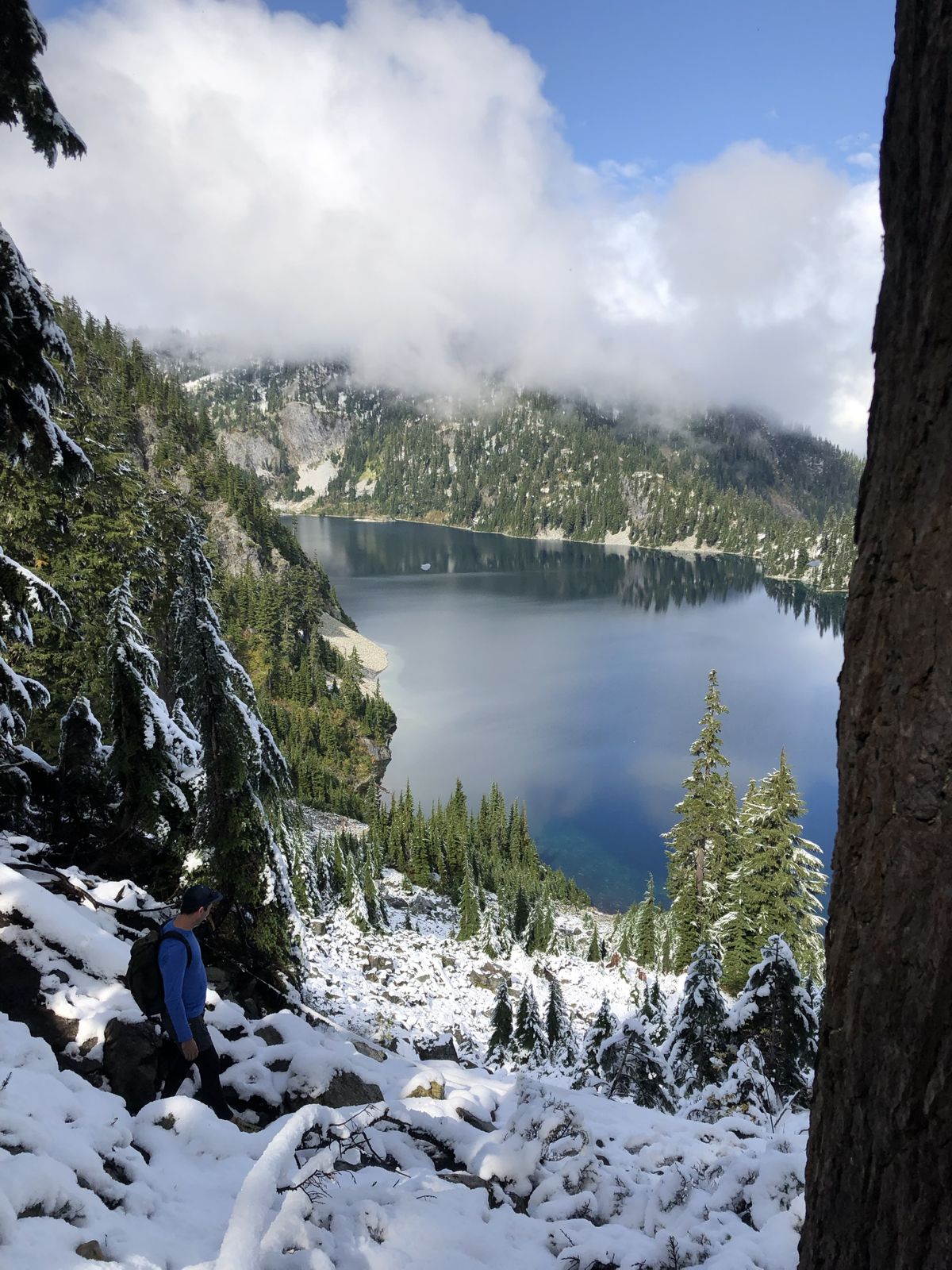
Clear water is the easiest to misjudge. Light slows down when it passes from air into water, and the slowing bends it. That bend lifts the bottom toward you, so a lake looks about three-quarters as deep as it really is. The clearer the water, the more sure you are about a depth you’ve got wrong. Clarity feels like closeness. It isn’t.
In 1999 a Harvard physicist named Lene Hau sent a laser through a cloud of sodium atoms cooled nearly to absolute zero and slowed light to about thirty-eight miles an hour. Two years later physicists stopped it outright, held it, and let it go again. Hau said it gave light a human dimension.
Sending is solved. The bottleneck now is on the receiving end, in how fast a person can take something in and make it theirs. So the work is her trick. Slow the light down to where someone can hold it, hold it yourself if you have to, and let it go when they’re ready.
What Gadamer called the in-between, the space between the familiar and the strange, I call an invitation. I’d add that the gap is deceptively foreshortened by modern tools, a deep blue hole and a window to an aquifer below, unknowably deep. Bridging the gap is a false hope, and most people settle for shouting across.
Understanding does not depend on closing the gap, despite all the tools available these days pulling toward clearer and quicker and more. Understanding asks for the opposite, a vessel held open long enough to learn how deep it goes and the nature of the far shore.
Held open and left dry, the gap is a crevasse, and someone puts up bright yellow signs to keep the tourists back from the edge. Filled too fast, the surface tension hides the depth, and it becomes easy to mistake clear for shallow.
We are still learning how to use LLMs to build shared understanding, and we don’t have the luxury of draining the Chesapeake to study what’s underneath before filling it again with perfectly clear data and sterile shared knowledge. We’d kill all the crabs if we did. Regardless, at some point you have to take the plunge.
My quintillions may have been right, but they were clear as mud.
Appendix: on slowing light
For Ashley, who shines an immeasurable light, and patiently untangles my metaphors.
The science
Hau’s group used a medium of sodium atoms cooled to a few hundred billionths of a degree above absolute zero (Hau et al., Nature 397, 594). On its own, the cloud is opaque to the pulse of light. The brilliance of her second, “coupling” laser, tuned to a neighboring atomic transition, makes the cloud transparent across a very narrow band of frequencies, an effect called electromagnetically induced transparency. Inside that window the refractive index changes steeply with frequency, and the pulse’s group velocity drops by a factor of about 18 million. Water, for comparison, slows light by a factor of just 1.33. As it slows, the pulse compresses, the way ocean waves bunch together when they slow over a shallow reef. Hundreds of meters of light in open air fit inside a fraction of a millimeter.
In 2001, Hau’s group stopped light entirely (Liu et al., Nature 409, 490), and a Harvard-Smithsonian team did the same in warm rubidium vapor. Switching off the coupling laser writes the pulse’s information into the atoms’ spin states. Switching it back on releases a matching pulse. In 2013, a Darmstadt group held light in a crystal for about a minute.
Two beams
The experiment uses two beams of light. One carries the information. The other, the coupling beam, decides what gets through. Without it the atoms block everything. With it they let in one narrow band and slow it down enough to observe.
We run the same experiment all day. Information is the first beam, and there’s more of it than ever. Attention is the second. Aim it on purpose at one thing, and slow that thing down until you can actually hold it. The rest can bounce off.
The lab version works because the medium is nearly motionless. I am not a cloud of sodium atoms supercooled to lab conditions. I need a medium I can deploy as needed, at whatever scale the storm calls for.
Vessels, by scale
Small: a single page, a question, a car ride. The drive with Wiley was one, a fixed stretch of time and one question worth sitting with.
Medium: a scheduled block, a walk, or a meeting with a set agenda and no phones.
Large: a person or a team you route things through. A partner or chief of staff can absorb the flood and release it to you at a pace you can use.
System: an agentic inbox that holds information until you’re ready to take it in. This is the closest match to stopped light. The pulse is stored intact and released only when attention pulls for it, the way a lean system pulls work instead of pushing it.
The blue hole
So we need a vessel. I was moving fast through these ideas, and the wayward Anaweka waka of my mind (a six-hundred-year-old voyaging canoe a storm uncovered on the New Zealand coast) knew to make for the slow water of Kosrae’s blue holes. The Blue Hole there is a deep, calm pool in the middle of the reef flat, between the surf line and the shore, where the remains of Kosraean kings were laid after temporary burial at the Insaru pyramids. Its walls really do hold the past. Storm waves stir the water only to about half their wavelength, and below that it is calm. The depth itself induces the stillness, no supercooled atoms required.
These holes are viewing ports down into a well of understanding we have already taken in, where the heavy wind and rain above are absorbed and accepted. Our eyes and ears are the surface, and the storm of news and inputs passes over it. When the light reaches the stiller walls below, new ideas take on the crystalline blue of past experience, lit by reflections and refractions from the light arriving slowly from above.
My mom has spent the last few winters on Kosrae, helping protect its ka forest, the largest stand of those trees left in the world. Time slows enough there for her to make the human version of warm rubidium vapor.
Links
Hau, Harris, Dutton and Behroozi, Light speed reduction to 17 metres per second in an ultracold atomic gas, Nature 397, 594 (1999).
Liu, Dutton, Behroozi and Hau, Observation of coherent optical information storage in an atomic medium using halted light pulses, Nature 409, 490 (2001).
Phillips, Fleischhauer, Mair, Walsworth and Lukin, Storage of light in atomic vapor, Physical Review Letters 86, 783 (2001).
Heinze, Hubrich and Halfmann, Stopped light and image storage by electromagnetically induced transparency up to the regime of one minute, Physical Review Letters 111, 033601 (2013).
Slow light, Wikipedia, for the general background.
Johns, Irwin and Sung, An early sophisticated East Polynesian voyaging canoe discovered on New Zealand’s coast, PNAS 111, 14728 (2014).
Snorkeling the Blue Hole, Kosrae Nautilus Resort, and Corals of Kosrae, Australian Museum, on the Blue Hole and the kings’ remains.
Yela Ka Forest, Wikipedia.