I read a Washington Post piece this weekend arguing that toxic multitasking is breaking our brains. It’s well articulated, and it’s an argument I keep hearing. And because my brain multitasks non-stop, I had Franklin’s daily schedule open in an adjacent tab before I was halfway through it.
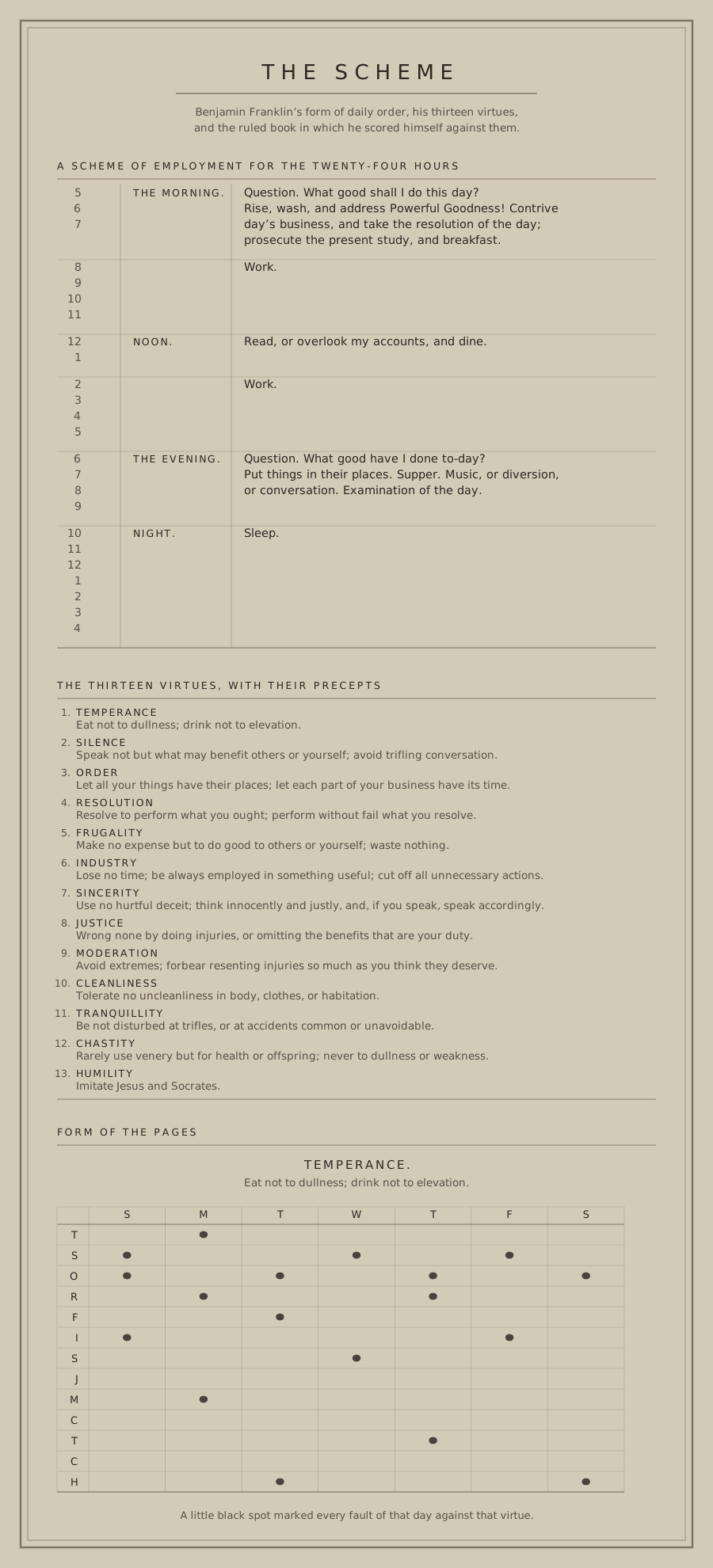
So while I was reading Franklin’s canonical take on this, I was mentally reviewing Allen’s. GTD: capture everything, clarify what it actually is, put it where it belongs, reflect on it. Keep it in a trusted system outside your head so your head is free for whatever is happening right now.
Franklin is the original time boxer. Allen breaks down what happens inside the hours. Different units, same concept. You have a thousand potatoes to peel, so decide when you’re going to do it, build a system to do it within, then get to it. Brilliant. Peeled potatoes. Neither of them engages with whether peeling potatoes is the right thing to be doing, or whether it was even work you chose, because they were both writing at a time when the opportunity set in front of an ordinary person had nothing like the variety it has now.
Every one of these systems is a product of its context. Franklin’s day got interrupted when a salesman knocked, or a small fire caught in the print shop, or there was a country to start. But time moved slower at that pace of communication, Europe was a ship away, and from that distance it would have been pretty hard to A/B test his dopamine. My bet is that the man was actively running several ideas at once inside those boxes. “Read, or overlook my accounts, and dine” probably looked like every account book open on the table, cross-referencing a web of information across every engagement he had going: professional, personal, governmental, and romantic. That last one was not a rounding error. The affairs were many, the affairs wanted gifts, and the gifts came with expenses that landed in the same ledgers as the print shop.
As I step out of Franklin’s drawing chambers and return to my train of thought, I approach the podium and in an authoritative voice boom: one score and one quarter ago, Allen took the pen and authored Getting Shit Done. Not quite as far back as the Gettysburg Address, but it might as well be.
Getting Shit Done is a TI-83 held up against Franklin’s lunch with the ledgers open. Allen was working with organizational capacity that by 2001 was far more broadly dispersed, and he turned it into the next canonical system. Better instrument, same arithmetic.
Neither system assumes attention is free and abundant. They assume the opposite. Attention is the fixed, finite thing. It has to be curated, rested for, and then spent very deliberately on whatever deserves it most. The time boxes and the organized lists exist for no other reason than to allocate attention correctly. That’s the key point. Those two systems are one system in different formatting.
Which is why the toxic multitasking framing misses. Franklin time-boxed precisely so that he could work on one thing at a time while many initiatives moved forward across the energy available in a day, without losing track of himself, his health, or his affairs. The nervous system claim is reasonable. It is also the thing both men already solved for: plenty in flight, but you do the one you are doing while you are doing it, and then you switch on purpose.
In a world with this much information arriving this fast, that skill has to evolve. Which is fine, and normal, and demands curation, regulation, and real rest to sustain a high rate of context switching. We are also supported by an absurd amount of tooling to augment it. But some things have not changed. The body came from a nervous monkey in a forest, and everything we are doing now is a hack on that system.
Which puts me back where Franklin started every morning, asking what good shall I do this day, and ended every night, asking what good have I done today. All the argument about whether we are doing too much or too little collapses into that. Did I do the thing I intended to do, and what can I do tomorrow to move it further.
The tension worth sitting with is just how to stay regulated, intentional, and productive when the pile in front of you is multiplying exponentially and, while the peeling itself may be machine augmented with recursive learning algorithms, the demand will always outpace the supply of the peeler’s attention and finger grip endurance prior to hand cramps. Where this whole genre of argument veers from useful into apologia for Luddites is the moment it answers this central tension by suggesting one should consider peeling fewer potatoes. The work is to choose the right potatoes, sharpen a paring knife, and get to peeling.